Design and production
A brown hat with a rounded top and a carrying loop
The only known surviving example of a 16th-century Monmouth cap is in the Monmouth Museum
The earliest surviving example is held by Monmouth Museum and was knitted from coarse two-ply wool. The cap was made by casting on at the lower edge and knitting in the round towards the top. The crown consists of a classic rounded top, with the last remaining stitches cast off. The yarn tail was wrapped around just below the cast-off stitches to gather them, leaving the little lump commonly, but inexactly, referred to as a button. The doubled brim was formed by picking up stitches inside the body of the cap and working down to the original cast-on. The cast-on loops were picked up, and a three-needle bind-off was worked to finish and join the inner brim to the outer cap, ending with a little loop.
Each hat was made weatherproof by felting, a process which reduced its size. The distance from the centre to the hem in this example varies between 5 inches (130 mm) and 6 inches (150 mm).
Thousands of Monmouth caps were made, but their relatively low cost and the ease with which the knitting could unravel mean that few remain.
Reproduction
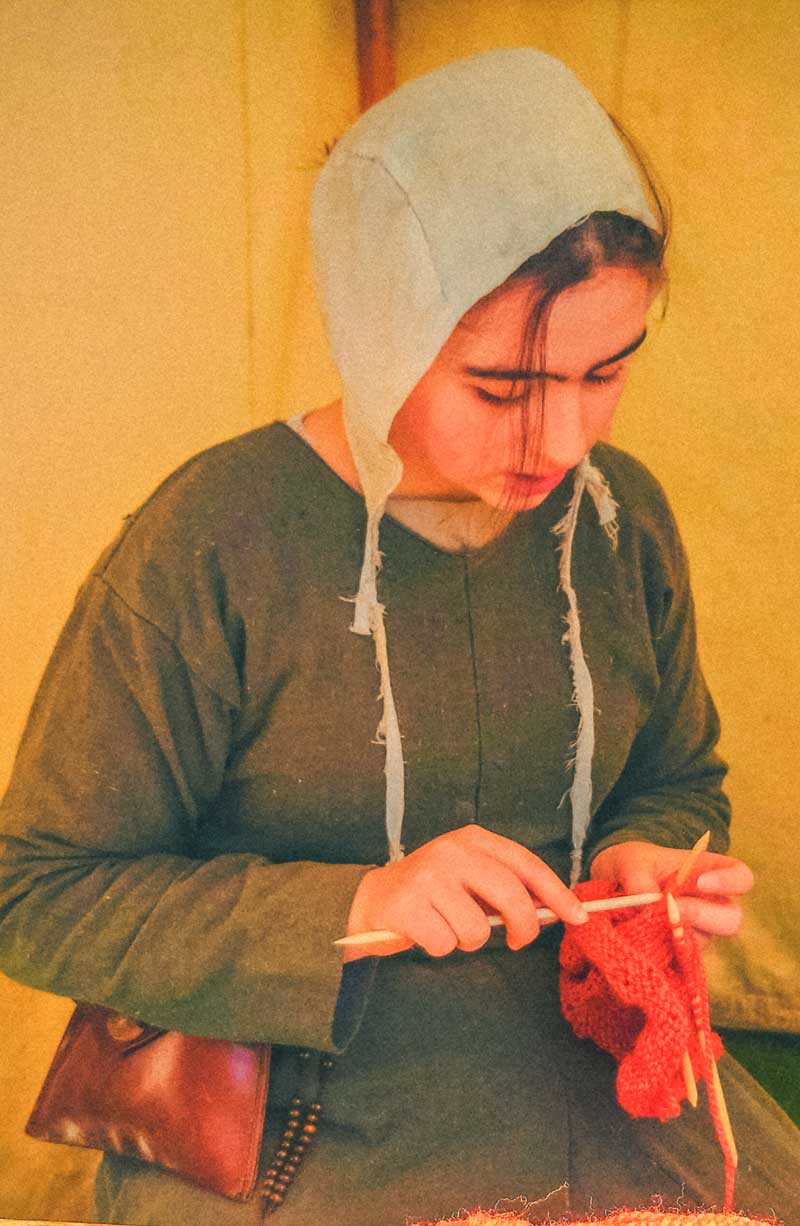
Similar caps are now produced for historical re-enactment organisations.
Patterns that attempt a stitch-for-stitch reproduction sometimes result in a cap that is slightly too narrow, after felting, due to the different felting characteristics of modern knitting yarn.